Showing posts with label singularity observatory. Show all posts

Saturday, May 2, 2020

Space1 Tent Observatory

The new tent observatory houses telescopes as large as a Celestron C14 Edge HD with a massive
CGX/L mounting and tripod. During days and nights, can be lifted up and off the telescope during
observing or the telescope can aim out the large roll-up zippered door. Photo shows the large size
with a 150 x 150 cm base and rose red color. The author is using the slightly thicker 190T blue
synthetic polyester 120 x 120 cm base which comfortably fits on a tiled floor of a high rise balcony
befit with a balustrade. Tie down straps are routed to the steel balustrade and piping.
Space1 & Singularity Observatory
New Tent Observatory
testing a new portable tent observatory for telescopes

During the heat of the day, the roof opens up
with semi-circular window to release heat. At
night, it helps to reach telescope thermal
equilibrium faster.
by Humanoido

Part of an ongoing expansion to the Singularity Observatory division of SPACE1 is a new tent observatory.

Sold at camping and sporting goods stores, the Singularity Observatory Tent Observatory SOTO is portable, opening up into a full observatory from a simple flexible folding steel pole that folds down after use.
About 5lbs, the portable tent observatory has a
flexible steel rod than folds up into a circle that
may fit under the arm.

Capacity
The tent holds or covers one telescope as measured for a full size Celestron C14-inch Edge HD OTA, which is 31-inches long, with a massive CGX/L equatorial mount and the largest Celestron tripod offered for this OTA. An even better fit is the Celestron 9.25-inch Edge HD with a 22-inch long OTA or other SCT. Remember to measure the mount counterweight when calculating size fit.
Remember to order the tent with the higher door, like the
two shown on the left. This will allow the telescope to
reach higher elevations when observing from inside the
tent.
Specifications
The tent is waterproof and has UV inhibitors for resistance to the sun. The tent is available in two sizes, small 120 x 120 x 190 and large 150 x 150 x 190 cm and is offered with different colors (camouflage, army green, orange, red, rose red, sapphire blue, luxury gold). The interior has a pouch which can be used like a small shelf for small lightweight telescope accessories. A strap near the top is ideal for hanging items, in particular a long flat lightweight poly pockets unit could be purchased extra and hold astro accessories.

Ordering
Originating from a camping sports company in Shanghai, China, the best part is the price - available for as low as US $16 online from AliExpress in China (before shipping). I had mine net ordered and couriered to a location in Shanghai, then hand delivered to me. Shipments to the USA could incur freight charges as high as $150 so shop around for a good carrier.

Construction
Made of 190T synthetic polyester, the weight is only 2.1 to 2.5 kgs (4.6 to 5.5 lbs) and one hand can move and position it. It has sewn in loops for attaching clips that can lead to tie down ropes, and a zippered door and windows. I prefer to use metal luggage clips for rapidly tying down and releasing the tent. Check with catalog listings as some tent colors are made from thicker weight material, such as blue sapphire. The large door opening can roll up and fasten with straps.

Applications
For use, the entire lightweight tent easily lifts up and off of the telescope as the bottom of the tent is open. After an observing session, just set the tent over the telescope and clip it down. The tent is lightweight and ideal for use on a deck. Depending on weather conditions, keeping it over the telescope is also a solution that could last several months. At the low $16 cost of the tent, it could easily be replaced every season.

Quick Covering
One use is as a telescope covering during a fast rain. Just quickly set the fully set up tent observatory over the telescope for protection.

Maintains Polar Alignment
Another use is to keep the telescope outdoors and covered after its aligned to the pole and star calibrated for precision GOTO.

Remote Imaging
The tent observatory polyester covering is transparent to WiFi signals so its ideal for remote imaging.

Good for Breaks
It also helps when using a telescope setup and you want to take a break at 4 am but don't want the telescope exposed to the weather. The tent is very handy to protect the setup throughout the night, when going inside for a quick nap, pause, cup of coffee, or intermittent breaks from observing.

Ideal for High Rise Balcony
A balcony may have a weight limit, as it hangs over the side of the building. After the weight of the telescope, a very light weight observatory covering is useful and necessary The light weight of only 5 lbs makes it ideal for setup on a highrise balcony and does not add any appreciable weight.

Observing from Inside the Observatory
Of course, if the object observed is visible through the opening, the tent observatory can provide a good sheltered place shielded from lights and wind.

Astro Imaging
It can also offer a suitable solution for astro imaging and remote control. It can make more nights usable for imaging by protecting against a strong breeze.

Daytime Shield
During the day, it will shield the telescope from the hot direct sunlight. The tent observatory will shield against sun, rain, wind, dust, lights and birds.

High Wind 
For those rare high wind events, typhoon or hurricanes, just fold the tent and bring it indoors with the telescope.

Observatory Door
The large zippered front door can be used like the bi-parting shutter doors on an observatory dome. It can partially open by folding over to one side the desired amount - good for stopping a wind or breeze. The door does not reach the zenith overhead, but this is ok on a deck with a partial roof. As the telescope is set closest to the front door, it has the largest viewpoint.

No Construction
No need to build this observatory - it comes ready to pop open instantly and assume its natural form. No tools needed.

Instant Setup & Takedown
No need to thread flexible supports and pipes like other tents. This tent is already constructed with built in flexible supports that "pop open" and just fold it to compress it down into its carry bag.

Portability
The tent observatory is ideal for a portable rig. It weighs almost nothing and sets flat when folded. Just fold up the tent and put it in the car along with the telescope and gear.

Fast Deployment
At the field site, it instantly pops open without any complicated assembly. No need to waste precious imaging time with rotating domes, opening bi-parting shutters, using motor drives or rolling off roofs.

Ventilation
The observatory has good ventilation as it can be regulated with the open bottom (no floor) or the window hatches at the top and side.

Caveat
The tent does not secure items inside from theft so it must be kept in a secured location or have eyes on it at all times. However, this may not be much of a problem for a secured balcony a thousand feet high off the side of a skyscraper. The tent is not permanent and not designed for high wind, but given  proper care it could potentially last years.

Thursday, April 23, 2020

Roof Top Observatory

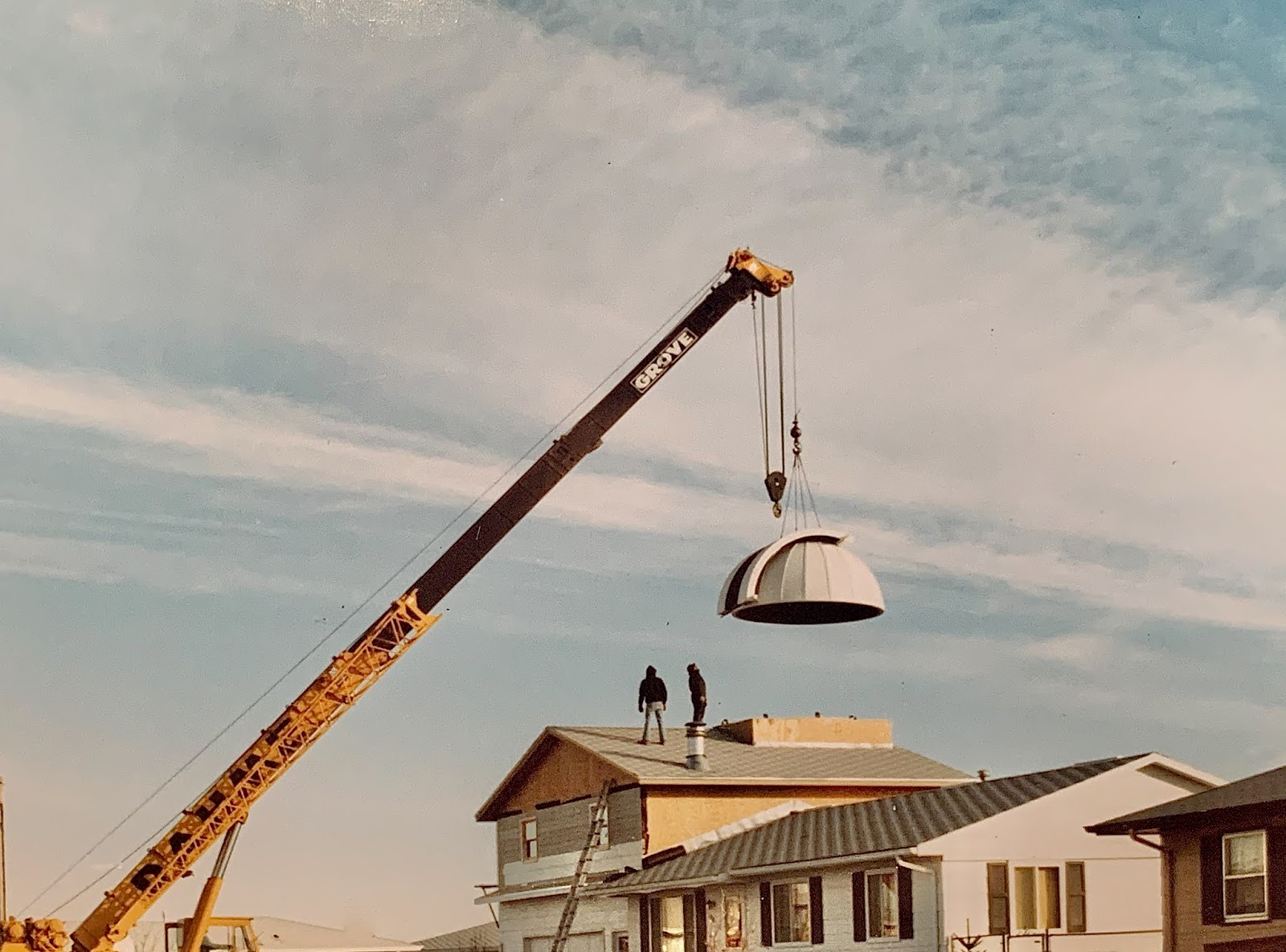
Hoisting the dome by crane was a three person operation. One person operated the
construction crane and two helped guide the dome down onto its observatory trucks. The
entire operation went smoothly and the dome mated perfectly with the track. In the final
analysis, the dome was built by the author with a roundness accuracy of +- 1/8th inch to
its three meter diameter.
Roof Top Astronomical Observatory
Spectacular garage-top observatory

Authored by Humanoido

Humanoido worked eighteen years developing, constructing, and perfecting performance of this fantastic award winning, and claimed by many to be far ahead of its time, computerized rooftop observatory

Ahead of its time: the observatory was far ahead of its time in the 1970s with many new inventions not commercially available at that time, such as a microcomputer, computerized mirror grinding machine, video image processor machine, special 40-inch telescope with servo figured primary, talking and listening speech observatory system, optoelectronics interface, OPTICS language, observatory robot droid, Thermodynamic Equalizer, the first GOTO celestial objects system, observatory HVAC, virtual cooling CCD, interlocking dome and track, the first cyber space robotic telescope, large lenseless Schmidt, infinite rate VFO...

Telescopes
(1) 30mm Refractor
(1) 4.25-inch diameter RFT Space Telescope
(1) 4.25-inch f/11 Newtonian Reflector
(1) 8-inch f/2 Lensless Schmidt Camera
(2) 8-inch f/6 Newtonian
(2) 12.5-inch f6.3 Newtonian Reflector
(1) 40-inch Newtonian with plate glass primary
(2) 50-inch Newtonian (aluminized polymer primary)

The biparting shutter doors were opened and four ropes
were attached to wood flanks on the dome's indoor side

partition. This was connected to the crane for lifting and
supported the dome's tonnage with perfect balance.
Largest Telescopes in the World
It was practically effortless to lift the dome up onto the
observatory using this massive crane. The crane operator
said he had lifted some unusual things in his career, like a
horse, but never an observatory dome.
The first telescope systems
design program executed in
BASIC and included many
telescope subroutines, like the

one shown above, that
helped in designing the 40"
diameter reflector telescope.

In the example sub code, a
multiple mirror telescope
MMT was considered.
It took 10 years to build the 40-inch telescope. At the time, the 40-inch telescope was the largest amateur size telescope in the world. The 40-inch was constructed from a large round of fine annealed Belgian plate glass. It was ground and polished on both sides.

The mirror mount was made from plywood with 144 computer controlled servos to figure the telescope objective shape during observing through machine induced flexure.

The mount for the massive telescope was disguised by building it into an outdoor backyard storage shed. The completed 40-inch telescope was valued at 1.2 million dollars.

Telescope Systems Design Program
A computer program was written on the 1802 microcomputer to design the 40-inch reflector telescope and diagonal. The program also determined the height to the ocular and many other parameters. Using the program, it was decided to figure the main objective electronically during observing by the use of homemade servos. Whenever a new computer was added, the program was rewritten and updated to the new language.

The observatory robot droid was
programmed to assist during
telescope operations. It could
speak, understand speech, move
around, detect smoke, and see in
total darkness.
Mirror Grinding Machine
To help grind and polish such large heavy telescope mirrors, a mirror grinding machine was computer designed and built using the 1802 computer. Built from scavenged parts, it included a 6-foot long solid wood house door, a tangent arm from a house beam, belts and pulleys from the surplus center, ball bearings from slingshot steel balls, timing cycles was on the embedded kitchen clock, and the motor from the family washing machine produced the reciprocating power. It could handle small eyepiece lenses on specific spindles or primary mirrors up to 40-inches in diameter at the core platform.

Mirror Grinding Room
For housing the mirror grinding machine in pristine conditions, a special mirror grinding clean room was constructed on the south wing.

Photographic Darkroom
Adjacent was a photographic darkroom for developing film, spectroscopic emulsions, designing developers, and printing images with a photographic enlarger, print paper and mixed chemicals.

Observatory Dome
The author designed and built the telescope dome with trigonometry and calculus. A double size garage was built onto the house as a work room. Construction first proceeded on the dome outside in warm weather, then was moved inside the new garage when weather turned cold and it snowed. A propane heater helped extend the project to 3 months. Humanoido built the two ton 3-meter observatory telescope dome with bi-parting shutter doors using metal garage track wheels, during his lunch breaks and in his spare time after work hours. Upon completion, small diameter long steel rod/pipes were used as rollers to transport the dome out of the garage in preparation of hoisting up onto the roof. The rollers worked so well that the dome started to pick up speed moving down the driveway. Running to the opposite side forced the dome from moving out into the line of street traffic! The dome was valued at $50,000 by astronomical sources.

Dome Drive
A special order expensive industrial AC motor was phase wired and set up with a machined keyed drive wheel in the ratio of 144:1 to move a precision welded circular steel track 360 continuous degrees. A controller was computer designed and built with electronics and high powered electromechanical relays and an HVAC unit for forward and reverse direction ability.

Precision Dome Support
Large custom support trucks were constructed from 1/4-inch welded steel plate with adjustable steel wheels. Four such units were equidistant placed and contained 32,000 pound lockdown chains each.

The Optoelectronic Interface
To send signals across the observatory, Humanoido invented the the world's first astronomical Optoelectronic Interface. Light waves were sent across rooms to communicate with the observatory computer and control the HVAC system.

Optics Language
The author invented a new computer language named OPTICS that could communicate across space and time with invisible optical components at the speed of light. This eliminated the need for bulky wires and cables and prevented any power line fluctuations and HVAC voltage spikes from getting into the system.

Telescope Pier
The massive solid stationary telescope pier began 9-feet underground and extended upwards 22 feet high. With an 8-inch diameter cast pipe in the center, it weighed 28,000 pounds and was constructed from steel, cement, rebar, and wire mesh. With thousands of pounds PSI, it was poured in three massive interlocking sections with thick 3/4" plywood forms reinforced with multiple long threaded rod bolts. Engineers estimated the telescope monolithic pier would survive a nuclear blast.

Computers
As the Observatory evolved, at least five computers were added to the systems. At first, the homebuilt 1802 computer was the mainstay for power programs to design the telescopes and do complex engineering. A Z80 was in charge of mobile robotic control and the Intel PC became part of the telescope sky celestial object positioning system. The 6502 did image and data processing and hosted the VIP Video Image Processor. The model I level II was allocated to the first AI speech recognition, speech synthesis and HVAC (High Voltage AC Controller) optoelectronic interfacing. Additional systems controlled dome rotation, thermal equalization, and a variable frequency oscillator for guiding and tracking stellar objects, plus the telescope was upgraded for computer control and slow motion in both right ascension and declination.

Science Library
The finished observatory included one of the finest scientific and astronomical libraries in the entire state, with rows 40-feet long and thousands of books from floor to ceiling. Many books were procured from a local library that closed. Also many university level books were contributed. Sections were included for astronomy, astrophotography, photography, chemistry, rocketry, space exploration, physics, optics, space time relativity, history, economics, music, robots, electronics, construction, carpentry, electrical wiring, plumbing, aviation, art, design, engineering, crafts & lore, materials, gardening, software, programming, artificial intelligence, SWL, ham radio, thermodynamics, atomic & nuclear, statistics, mathematics up to differential equations, and computers. It also include the first 35 stories written by the author for publication.

Publications
The observatory details, observations,  etc. were written up and published in newspapers, carried nationally by News AP Wirephoto, news journals, books, Observatory Techniques Magazine, Sky & Telescope and other astro publications.

Laboratory
A large laboratory equipment bench had sections for robotics, cybernetics, computers, software programming, optics, droid construction, image processing, and inventions. It had a vast network of storage to hold computer drives and various observatory equipment.

Room Construction
Upgraded microcomputer in the observatory
Everything was deluxe. The extra wide oak colonial post stairway led up to the observatory hallway where picture frames were lined up on the wall, of great scientists and the best photos from the observatory telescopes. On cold days,  heat was from a triple insulated air tight wood stove and electric heat panels. To the side was corded firewood, axe split outside the backyard. In summer an air conditioner cooled the area. Included were a humidifier and dehumidifier. Oakwood-walled rooms were carpeted throughout. A short stairway led to the dome room. R128 and higher insulation was installed and the structural heat and any vibrations were isolated from the telescope for greatest stability. Rooms included the garage, dome room, mirror grinding room and meeting room, photographic darkroom, library, large laboratory (cybernetics, AI, programming, electronics, image processing, computing, inventions), equipment storage room, and the staircase room.

Special Garage
The 2.5X garage was reinforced to support the weight of the entire observatory complex with a custom forged beam of multiple sandwiched massive wood lengths with layered steel plate running the entire length of the garage. It led to two vertical posts sunk into poured concrete footings four feet deep. To provide weather and temperature separation, the garage was fully insulated and sheet-rocked. Built with extra-large service doors, the car was kept outside, and half the garage was used for constructing the large 40-inch telescope. The garage was heated by propane and was instrumental in dome construction during cold winter months.

Observatory with a Voice
The observatory could talk and recognize speech. Experiments were conducted with chips that included VOTRAX, RS, and the SPO256. By giving it commands, the dome could rotate to match observing the stars and celestial objects. There was AI behind the voice, which at times on the main floor would suddenly start talking out loud to itself. One time, it was startling to think a stranger was lurking somewhere upstairs in the observatory, but it was only the AI that auto-reset and  started talking to itself!

Telescope
The telescope was the first high tech GOTO system that could find celestial objects using a telescope axis drive, variable frequency oscillator, encoders, software and a computer. Adjustments were made during astro imaging using both R.A. and Dec. slow motion controls. The system was implemented on planets such as Venus, Mars and Jupiter, and could track the Moon using Lunar rate. For deep sky, sidereal rate was highly accurate. Also implemented was a solar rate and an adjustable rate for comets, satellites and asteroids.

Cameras
A variety of custom astro imaging cameras were used, including CCTV, SLR, super cooled homebuilt dry ice camera, a virtual cooling CCD, and ST-4 Peltier cooled imager and guider.

The 1st Microcomputer
A microcomputer designed and built by the author was used extensively at the observatory. This was created before any microcomputers were on the market. The computer was built around the RCACDP1802MPU chip and was upgraded to run Tom Pittman Tiny BASIC in 4K. To have more power, it was expanded with more memory, an ASCII keyboard, tape recording and loading machine, extended power supply, meter, TV monitor made with a 5" SONY portable TV, and RF Video Modulator. The author lectured at universities regarding the design of his first new microcomputer and was published in several computer magazines.

Cybernetics Lab - Robot Droid - Cyber Space Telescope
Many inventions came from the Observatory Cybernetics Lab. The author built a mobile AI robot droid based on the Z80 chip to assist observatory operations by providing the correct observing oculars, speaking timing routines for astro imaging in total darkness, and keeping track of technical information for observing, dome rotation, and special astro missions. The robot was taken to Albuquerque NM at the World's 1st Personal Robotic Conference (IPRC) where it received the red ribbon. Other inventions included a robotics hand, machine video image processor, AI creations, and robot telescopes. This led to the world's first Cyber Space Robotic Telescope where people from across the world could dial up the telescope by internet and take photos of sky M-objects and selected objects using a choice of CCD cameras. It included star maps and an online data accessible astro computer.

Thermodynamic Equalizer TE
The TE was an electronic machine invented and constructed by the author. Using thermoelectric sensors and comparator circuits, it equalized the temperature of indoors and outdoors to keep the telescope and dome room at thermal equilibrium resulting in the finest performances.

VIP Video Image Processor
A six-foot-long machine was invented that could take negatives and convert to digital images and do computer color image processing. The red machine was built from plywood, an enlarger lens, a homemade servo, screw focus assembly, and a microcomputer with special interface. This machine helped discover radial spokes in the colorful rings around planet Saturn and was one of the first computer image processing systems applied to astronomical imaging.

Guest Visitors
The observatory had many guest visitors. Some were visiting astronomers from across the world, and others were visiting schools. Perhaps the most valued and cherished visit was from the Great Grandmother, who somehow made it up the two flights of steps to see the observatory and telescope in operation. She is quoted as saying, "I have seen the future!"

Discoveries & Inventions
The observatory helped to make thousands of inventions and important discoveries. This is the short list.
* Found new star in M27, helped position the HST Hubble Space Telescope
* New Comet understanding of formation and evolution
* New Cometary graphics
* New astrophotographic techniques
* New maps - discovered and tracked Mars dust storms
* Discovered radial spokes within the rings of Saturn
* Discovered Virtual CCD cooling
* Discovered new imaging techniques
* Discovered new ways to build large telescopes
* New optical experiments
* Invented anti-light device
* Cyber Space Robotic Telescope
* Special "figuring the primary objective during observing" method
* Discovered telescope Amping & implemented their new systems
* Discovered how to reduce EFL by electronic techniques

History, Demise
The observatory was extremely successful and active up until the time someone tore down the observatory and crushed the dome. At the same time, another person took a hammer to the 40-inch telescope glass, thus destroying the 1.2 million dollar telescope. Only the 28,000 pound steel/concrete pier remains to this day, an immovable monument to the observatory history.

Rebirth
Nearly 2 decades transpired. Suddenly the timing was right to "take back the observatory" so to speak. At the Pacific Ocean Volcanic Archipelagos, a replacement futuristic new observatory was born, literally hundreds of thousands of times more powerful than the original, and ultimately equipped with the largest and most powerful amped telescopes in the world.

Wednesday, April 22, 2020

Singularity Observatory Covid-19 Delays

Singularity Observatory Telescope with Covid-19 Delays
The third massive telescope construction project in 2020 is significantly delayed by the Corona-19 Pandemic

Delays for the third telescope include orders that companies refuse to ship, indefinitely. This has delayed the third telescope project significantly, and work is being diverted to telescope number two (the 1,325-inch diameter monster). Many of the design features of the potential third telescope are now being designed into the second telescope. Telescope two has all but one of the accessories needed for full operation using new technology in 2020.

Tuesday, April 21, 2020

Singularity Observatory Expands Largest Telescopes

Singularity Observatory Expands the Two Largest Amped Telescopes in the World
Expanding both telescopes is a top priority for Singularity Observatory, working its magic on the massive mirrors.

Singularity is working on both telescopes, the massive 1,800-inch and the 1,325-inch mirrored beasts. Spring preparations are underway to install all new high technology components. Currently the 1,325-inch is a priority as the entire telescope is being outfitted with extreme technology. In particular, Focus will be hands off and conducted entirely from electronics and optics. A number of extreme technology parts are in the order cache though the Covid-19 virus pandemic world wide is causing delays.

Monday, April 20, 2020

Singularity Observatory Eyes Third Telescope

Singularity Observatory Eyes Third Telescope
Singularity Observatory, after the massive investment of two world's largest amped telescopes (the 1,325-inch and 1,800-inch) is now eying a third powerful telescope to form a metrical astro triage

Humanoido, Observatory Director of Singularity Observatory, announces a new third telescope in the works and it will become the smallest (450-inches) of the large aperture telescopes at the Singularity Observatory Pacific location. The telescope is auto amped and has a special design to penetrate haze, fog, smog, air pollution, specific cloud types, and light pollution of varying degrees. This opens up to fifty percent more potential observing nights per year. The third telescope is extremely portable and can be taken far up into the largest volcanic Pacific mountain range for the ultimate in DSO penetration.

Third Telescope Specs
Amping Levels - 10X & 100X
Aperture - 450 inches Diameter
Mount - Altazimuth
Stellar Polar Alignment - Automatic
Object GOTO - Automatic
Mounting Calibration - Automatic
Database - Yes
Calculated Objects Per Night - Yes
Augmented Reality - As Needed
Star & Mounting Calibration - Automatic
Designation - Prime Deep Sky
Multiple Image Alignment - Automatic
Enhance Software - Automatic
CCD Sensor - SONY IMX224
Sensor Size - 1/3"
Sensor Pixels - 1.2M
Sensor - SONY Exmor & NIR Tech
Amp - Anti Amp Glow
Read Noise - Extremely Low 0.75e – 1.5 e
Sensor Comparable - sCMOS or emCCD
Wavelength Sensitivity - High in IR range
DSO Software - Auto
Power - Lithium Ion
Rechargeable - Yes
Other Telescopes - 1,325-inch and 1,800-inch

Wednesday, April 15, 2020

Singularity Observatory M27 Dumbell Nebula

Singularity Observatory
Singularity Observatory M27 Dumbell Nebula

Using the latest combination of large telescope focal reduction, the image of M27 Dumbbell Nebula is so spectacular, we were a little worried about the light intensity burning into the CCD sensor. This image is toned down by image processing, yet still retains the brilliant color and deep magnitude penetration.

https://space1usa.blogspot.com/2019/04/singularity-observatory-telescope.html
https://space1usa.blogspot.com/2019/03/space1-singlularity-observatory.html

Tuesday, April 14, 2020

Singularity Observatory Center of M57 Ring Nebula

Singularity Observatory
Journey through the Center of M57 Ring Nebula

Ultra deep black & white magnitude processing of this image allows a peek into and through the center of M57 - the Ring Nebula, to see stars, galaxies and material on the other side. About fifty stars are visible at or through the inside the ring along with wispy material from the extended ring structure.

Monday, April 13, 2020

Singularity Observatory Prepping Telescopes

The Moon First Light imaged by Humanoido
at Singularity Observatory from March
2019 using a phone camera.
Singularity Observatory Prepping Observatory Telescopes

Singularity Observatory is Prepping its Two Prized Telescopes

The key feature this year is prepping both prized telescopes for more complete remote function. The idea is to control all aspects of the telescopes from indoor comfort, avoiding mosquitoes, heat, and humidity. It also allows for telescope setup and no need to go through extensive recalibration each time. This year, the addition of a remote controlled motor focus in in the works. This will supplement telescope control, positioning and GOTO with WiFi, enabling more effective lunar and planetary imaging, and the introduction of deep sky work.

Sunday, March 22, 2020

Singularity Observatory Mars Prep

Taking mother and baby telescopes out of storage for the new summer apparition for the Moon
and planets - a Celestron C14 Edge HD and Celestron C9.25 Edge HD both with the newest
ultra enhanced coatings that increase apparent diameters of 14 and 9.25-inches. The F/10
FRs are ideal for Lunar and Planetary study, including the entire Mars Opposition. The 9.25"
scope will get the same super heavyweight and stable Celestron CGX-L Equatorial 1400
EdgeHD GOTO computerized mounting with 75-lb capacity, StarSense Auto Align and
SkyPortal WiFi Module. The mount has a very large 144mm diameter worm wheel for
exceptional guiding and tracking. These are the only two documented telescopes that
Celestron professionally reworks optically to exacting precision specifications above and
beyond that of standard commercial telescopes.
Singularity Observatory Mars Prep
Summer is here on this side of the Earth. Telescopes are being awakened at Singularity Observatory by Humanoido, Observatory Director and Founder

Now at only 6" of arc in diameter in the early morning sky, Mars is but a tiny dot moving closer to the Earth, culminating in a close approach opposition in October where it will reach about 23" in diameter. There is always the risk of global wide dust storms so there is no guarantee as the clarity of surface features for mapping.

2020 Mars approach details - it's unknown if the days of closest approach will end up with
a massive global Mars dust storm like two years ago, but as Mars seasonally warms up and
the polar cap melts, one can expect turbulent weather and storms to occur.
Skies in the Pacific are clearing, as today has a slight haze cast - frequently superior for observing planets with results similar to that through a filter that increases accuity and visibility of planetary features.

This year, the observatory has installed large storage units for telescope equipment during day night observing. Also visible near Mars, are Saturn and Jupiter, ideal for honing this years observational and imaging techniques with new equipment.

Humanoido is currently starting up the C9.25-inch Edge HD telescope and the C14-inch Edge HD at the Pacific installation. As the distant mountains come into clear focus, many new discoveries are expected with the ultimate sky clearing.

Singularity Observatory Indoor Observing Success!
https://space1usa.blogspot.com/2019/03/space1-singularity-observatory-indoor.html

Monday, March 16, 2020

Singularity Observatory Photonic device

A quick shot of M31 Andromeda Galaxy
Singularity Observatory Photonic Device Runs Amok
Humanoido, Observatory Director and Founder of Singularity Observatory, is preparing a very advanced Photonic Device for the two largest telescopes in the world

The device handles the largest number of astronomical parameters at one time of any photonic device previously used at the observatory. The Photonic can select and handle highly specific parameters to create new capturing and visionary inventions for the telescopes.

The device is deep end capable, for the largest and deepest spectroscopic range of any device thus far, along with the deepest dimensional penetration which is software selectable. We are eager to try this on Mars.

Sunday, March 15, 2020

Singularity Observatory New Telescope

Singularity Observatory New Amped Telescope is 2nd Largest in the World
Singularity Observatory is now preparing the Ultimate New Telescope for the next seasonal apparitions in the night sky

by Humanoido - Observatory Director

As you may recall, the giant new telescope on Earth out in the Pacific Ocean, barely out of the parts boxes and engineering completed and tested, is a 1,325-inch diameter amped scope capable of making megalithic discoveries. Of course, the enhanced dialectric emulsions deposited on the glass make the telescope perform significantly larger as previously calculated.

The only thing holding back this telescope is the wait for the correct usage season with the finest weather and the most important oppositions and apparitions. As far as we can tell, the best seasonal conditions are beginning from March 15th, 2020 and should be inforce generally through the summer and fall seasons.

Given the window of opportunity for such a large telescope, a viewing port is established from the most massive and solid GOTO mount in the country to engage in research programs with Mars, Jupiter, Saturn and the Moon which now command the sky in the am hours. Jupiter is the second brightest object. Climbing up to the visual ocular is not necessary as electronic optronic devices with a myriad of photosites will capture images. The telescope is fully equipped with some of the most advanced viewing accessories, generally borrowed from the World's Largest Amped Telescope, the incredibly massive 1,800-inch diameter behemoth. Especially notable are the finest oculars with 2-inch focus and a set of imaging focal reducers that take the focal ratio to a new world. For example, F2, F1 and F.1 make objects like the bright Orion Nebula appear greatly overexposed, literally giving new meaning to burning an image into the photonic capture devices.

Space1 Singularity Observatory Ramp Up - March 2019
https://space1usa.blogspot.com/2019/03/space1-singularity-observatory-ramp-up.html
HSO Largest Amped Telescope in the World - June 2018
https://space1usa.blogspot.com/2018/06/hso-largest-telescope-in-world.html
HSO Humanoido Singularity Observatory - May 2018
https://space1usa.blogspot.com/2018/05/humanoido-singularity-observatory.html
Space1 May 2018 Update - May 2018
https://space1usa.blogspot.com/2018/05/space1-may-2018-update.html
Space1 News Alert April 2018 - April 2018
https://space1usa.blogspot.com/2018/04/space1-news-alert-april-2018.html
Space1 Astronomical Technology - April 2018
https://space1usa.blogspot.com/2018/04/space1-astronomical-technology.html
Space1 Singularity Observatory - April 2018
https://space1usa.blogspot.com/2018/04/space1-singularity-observatory.html
Singularity Observatory Mars 2020 - December 2019
https://space1usa.blogspot.com/2019/12/singularity-observatory-mars-2020.html
HSO Amping Pretests - June 2018
https://space1usa.blogspot.com/2018/06/hso-amping-pretests.html
Singularity Observatory New Telescope (1,325-inch)
https://space1usa.blogspot.com/2019/04/singularity-observatory-new-telescope.html
1,325-inch Diameter Telescope - March 2019
https://space1usa.blogspot.com/2019/03/space1-singularity-observatory-1125.html
Observatory Ramp Up - March 2019
https://space1usa.blogspot.com/2019/03/space1-singularity-observatory-ramp-up.html
Telescope Gone Wild - March 2019
https://space1usa.blogspot.com/2019/03/space1-singlularity-observatory.html
Singularity Observatory Big & Little Brother Monster telescopes - March 2019
https://space1usa.blogspot.com/2019/04/singularity-observatory-big-little.html
Exampling 34-meter Telescope Spectacular Performance - March 2019
https://space1usa.blogspot.com/2019/03/space1-singlularityobservatory.html
Singularity Observatory Humanoido Musings
Story of the Growing Telescope - March 2019
https://space1usa.blogspot.com/2019/04/singularity-observatory-humanoido.html
Singularity Observatory Telescope Visual Treat - March 2019
https://space1usa.blogspot.com/2019/04/singularity-observatory-humanoido.html
Singularity Observatory Glass Amping - March 2019
https://space1usa.blogspot.com/2019/03/space1-glass-amping-singularity.html
Singularity Observatory Great Adventure - March 2019
https://space1usa.blogspot.com/2019/03/space1-singularity-observatory-great.html

Tuesday, March 10, 2020

Singularity Observatory Remote Mountain Study

The author has developed a remote and safe way to study wildlife and fauna in the mountains of
Taiwan from a safe distance. Trekking on the mountain in person and exposing one's self to
wild predators is extremely dangerous including the possibility of being eaten by a wild black
bear.
A Study of Remote Mountain Wildlife and Fauna by the Repurposing of Aplanatic HD Schmidt Cassegrain Amped Catadioptrics

by Humanoido @ Singularity Observatory & SPACE1 Industries

Like the unperturbed evolution of wildlife on the Galapagos Islands, it’s imperative to safely study the ecology of jungle forest mountain wildlife and fauna within the Arpeggio Mountain Pacific Rift without disturbing surrounding ongoing evolution.

How to conduct a useful scientific study without actually trekking into the dangerous and treacherous mountainous regions and disturbing the pristine footprint of millions of years of ecology?

The author has developed an inventive application to monitor mountain vegetation and wildlife from a distance of up to twenty or more miles away depending on conditions. The instrument is a modified and enhanced catadioptric with an amped aperture over 1,400-inches in diameter. The program includes studies of animals, insects, birds, reptiles, plants, aquatics and any species within the instrument’s resolution at the time of given atmospheric conditions.

The conservationist program is conducted by Humanoido from a distance of about ten miles. The instrument is optically driven with multiple surfaces of fourth order differential curves, amplification equipment, dialectric filtering and specialized oculars. The obs recording device is a specialized Deep CCD array with a high density multi core receiver for Tb data. The gathered data is then fed into a mating reciprocating machine - the Reciprocal Image Determinator, that enhances results.

The system includes the following programs of tremendous importance:

* The variety of plant and animal species are recorded and counted
* Forest Jungle densities and habitats are determined
* A determination is made for species counts as to whether the subject is going extinct or nominal in population
* New species are discovered and cataloged
* The evolution of jungle and forest is recorded along with any precipatating changes
* Activities of corresponding weather, seasonal conditions and changes are recorded
* Forest Jungle locations are noted for their densities of land, jungle vegetation, and animal density and types
* Mountain cartographic divisions are mapped out to specifications

Given the setup of the system, trekking into the mountain by proxi with the technology is convenient and completely safe from poisonous spiders, snakes, killer wasps and bees, stinging army ants, poisonous beetles, harmful Komodo dragon Monitors, alligators, leeches and slugs, fungi and bacterial diseases, deadly virus mitigations, and other killer species. The system is convenient, and can be conducted from an outdoor deck or free open area in line of site to the Pacific mountain range.

Friday, February 28, 2020

Singularity Observatory Weather Polartron

Strange Weather Station
Singularity Observatory Weather Polartron Machine
Singularity Observatory invents fantastic Polartron weather machine

Humanoido at Singularity Observatory has invented the World's only singularity Polartron Weather Machine to more accurately determine astronomical observing weather.

Astronomical seeing, clouds, changing weather patterns, moisture vapor, fog, wind, rain, dew point, and air particulates, all contribute to changing weather. Using the Polatron, determinations are made for weather conclusions with clouds, astronomical seeing conditions, the degree of airborne pollution and contaminants, and air water content. Polartrons work with the numerical machine parametric angle and cardinal directional alignment of prevailing weather parameters. With the upcoming planetary conjunctions and oppositions, the Polartron will be vital in conducting numerous planetary and SPACE1 missions.

Monday, February 17, 2020

Space1 Colonizing Man Made Planets

Future improvements can include highways,
parks, rivers, and modern infrastructure
Expanding Humanity
Space1 Colonizing Man Made Planets
SPACE1 has created the world's first man made planet and taken it for a worldly spin in space

Designed for colonization of space, the small exampling artificial planet is filled with infrastructure, populated and then sent into space.

The planetary ball is first created from Duridium in the Lab, a heavy duty rubber-like material that can undergo atmospheric pressurization and the forces of gravity. "It can also endure the kinds of space temperatures that we will are subjecting it to," said Humanoido. A hatch is opened up on the ball and inside a number of resources and materials are implanted, stuck on the curvature. Then colonists are inserted into their respective habitats. These are special high technology colonists reduced down to the infinitesimal dimensions of the planet. (see previous blogs for details)

It's not the exterior of the planet that gets colonized, but rather the ulterior along the curving spherical inside surface. The planet will have imparted gravitational spin and depending on locations and trajectories will have places or periods of weightlessness. "The first planets are small," according to Humanoido, the inventor of the artificial planet. "We will populate the artificial planet with high tech colonists that are geometrically modded to fit the infinitesimal space, and provide an atmosphere and ecosystem for evolution to occur with the boundaries of space time compression." "Special fuel cells will provide planetary energy initially and in the future, solar energy will be collected and fed into the planet for power." "In some instances, the outside of the planet may be covered with solar cells."

Once lofted by a SPACE1 Super Rocket, the planet will spin up and the fantastic experiment will begin a limited time period of evolution. To maximum evo, the planet will be given space time compression, where more events can occur within a highly densified patch of space time. Data will be extracted from the artificial sphere to monitor the progress of the planet. A radio telescope transmitter inside the sphere will penetrate the thickened Duridium hull and outside, Singularity Observatory on Earth will operate its powerful XTREME Artificial Planet Telescope XAPT that tracks various trajectories, infinitesimal geometrics, and evo time compression periods. After fully developing the world's first artificial planet for space colonization and letting the experiment run its course, Humanoido expects to launch clusters of planets and expand humanity.

Singularity Observatory XTREME Artificial Planet Telescope XAPT


Singularity Observatory and the XTREME Artificial Planet Telescope XAPT

XTREME planets are observed through special high technology telescopes like the upcoming XAPT XTREME Artificial Planet Telescope that tracks various trajectories, infinitesimal geometrics, and evo time compression periods.

For observations, the XTREME artificial planet requires a special vision and tracking telescope that can see through the window of  compression space time, amplify geometrics of the infinitesimal, and penetrate the planet's crust with radio communications. Known as the XTREME Artificial Planet Telescope XAPT, there is only one on the lab design table at Singularity Observatory. When complete, it's destined to become the principle vestibule to keep in touch with the artificial planets of space colonization.

Saturday, December 7, 2019

Singularity Observatory Mars 2020

Examples of Mars diameters (apparent size) on July 31st 2018 at left and the predicted size on
October 6th 2020. The distances from Mars to the Earth are 35.8 and 38.6 million miles
respectively. Mars and the Earth line up for a close approach approximately every two years,
called an opposition. Some are favorable and some not. Barring any obliterating dust storms

during the oppositional time period of closest approach, Mars 2020 should yield to showing
some spectacular detail.
Singularity Observatory
Preparing for Mars 2020
All signs show Mars will become our future home when we become a multi-planetary species, therefore interest is ramping up like wildfire as Mars is making another close approach to the Earth in 2020. Now is the time to start preparing. If you missed Mars in 2018, the good news is Mars is once again making a very close approach to the Earth in upcoming 2020.

You still have enough time to purchase and arrange for delivery of a good size precision telescope in the diameter range of 4 to 16-inches for the best of Mars observing, watching its weather, seeing the changing polar cap made up of dry ice, performing routine planetary imaging with a CCD camera, and studying the surface features where future colonies will exist.

Barring any major dust storms like in 2018, a myriad of surface features will undoubtedly become visible in quality telescopes under skies of favorable seeing conditions. The apparent size difference from 35.8 in 2018 to 38.6 million miles in 2020 is minimal and viewing should be spectacular around the time of opposition, closest to the Earth on October 6th 2020.

Ramping Up Singularity Observatory for Mars
This year Singularity Observatory is prepared with two of the world's largest and most powerful amped telescopes, the fully functional and spectacular 1,325-inch telescope and the amazing 1,800-inch telescope. These telescopes are amped 100X and have their optical surfaces coated with specialized light constructive enhancing dielectrics.

1,800-inch Amped Telescope
https://space1usa.blogspot.com/2018/06/hso-largest-telescope-in-world.html

1,325-inch Amped Telescope
https://space1usa.blogspot.com/2019/03/space1-singularity-observatory-1125.html

Mars Speed
Mars is moving fast along in its elliptical orbit. It's speeding towards the Earth on the average at 53,687 miles an hour with its orbital speed. It will arrive closest to the Earth on October 6th 2020. However, given the variability in Mars conditions and the changing Earth's weather and seeing conditions, making observations at least a month before and a month after opposition is a good idea.

Mars Observing Prospects
Expect large Martian dust storms during Summer seasons when the SPC big melt is sublimating and CO2 and water vapor is deposited directly into the atmosphere. Catch the best surface views prior to any storm outbreaks.

Friday, December 6, 2019

Singularity Observatory Mars Compared

As Mars moves closer to the Earth
Singularity Observatory
Mars Compared
Don't believe what you think you see! Your eyes may deceive you! Compare the 1800s drawn Mars map view (at right) with the modern day view typical of high resolution telescopes, space telescopes and spacecraft to Mars. In the modern view, there are no canals.

In modern times, it was found that canals did not exist and were only in the over active imaginative minds of the Astronomers of the historical past. To add to the confusion, Italian astronomers saw channels, which they named with the Italian language word Canali, which was then confused with the English word Canal, which is man-made waterway. This spread the belief in that age that aliens existed on Mars and they channeled water from the ice polar cap using made canals. In high resolution telescopes, the canals were nonexistent and many craters and other objects appeared such as volcanoes, sand dunes, and ironically the evidence of dried up river beds from millions of years ago.