Showing posts with label monsoon. Show all posts

Wednesday, February 17, 2021

Rocket Countdown Hold

Rocket Countdown Hold

Being situated at the tail end of unusually long lasting Monsoon rain period, the SPACE1 EM Super rocket is in its erected skyward position with a protective covering and a countdown hold preventing current launch activity. Until the atmosphere releases it weather grip, SPACE1 will continue developing high tech projects and new inventions. One new invention is a spacecraft/rocket/satellite cloaking device to provide a sheath of invisibility.

Sunday, December 8, 2019

Space1 Trip to Mars

Using its massive EM rocket spacecraft, SPACE1 Industries expects to send a human to the Moon,
Mars and other locations in the solar system like Ganymede around Jupiter.
Space1 Trip to Mars
Will SPACE1 go to Mars?

We are grand bold explorers anxiously awaiting trips to the Earth's Moon, Mars, and the Solar System (Jupiter and Ganymede). It all depends on working technology and the weather. Weather will need to remain simultaneously good on the Earth and Mars to make the trip. This entails Earth weather, Solar weather, Martian weather, and space weather.

Thus far, the manned Moon landing was cancelled several times therefore missing the windows of rocket flight opportunity, due to fierce weather from the Monsoon period at the Pacific Ocean launch site. This weather has yet to clear and continues to postpone rocket flights to the Earth's Moon, Mars and other moons in the solar system. Several typhoons have passed and the weather continues to remain unstable after months and months of rocket preparations. When the season passes, SPACE1 will resume rocket flights into space.

Monday, June 3, 2019

Singularity Observatory Weather Errant


Great Weather Fluctuations - Grab the Moon Before it's Too Late!
If you see one clear hour, you'd better grab it! Singularity Observatory - in the Spring and Fall, there are subtle short term fluctuations in weather patterns that could easily go unnoticed.

The short term weather changes, with a clear sky for example, hold extreme value to the Observatory. The idea is to be ready and alert, and harness these changes by understanding the patterns and having preparedness to jump into action at a moment's notice.

In this Pacific Ocean region, there is great weather stability, so over the long term an overcast Monsoon fog day will be multiplied by many days. Day after day after day, it looks exactly like the same repeating weather. However, to the watchful eye, there are very short changes, such as an hour here, 20 minutes there, when the sky occasional breaks from its very consistent weather pattern.

Likewise a Summer clear day follows the same pattern of repeating longevity However there are occasional and intermittent very short term disruptions to these weather patterns that are very short lived. Disruptions can be good. Last night was a great opportunity, after months of Monsoon, to view the effects of a short lived disruption.

The entire day was overcast, fog, smog, rain. Suddenly in the evening hour, the sky became clear, the Moon appeared, and an hour later the clear sky had vanished just as fast as it appeared. Then for days, it will go back to the same weather pattern - overcast, fog, smog, rain. For the moment of that one golden treasurable hour, astronomical viewing was fantastic. Grab it and run with it. You've gotta do it, otherwise all astronomical observational programs during the Monsoon period will be on hold.

In regards to a telescope, an astronomer must be a detective sleuth ready at a moments notice to spring into action to capture these clear night hours here and there to conduct research and effective observational programs. There are no known studies of these holes in long term weather patterns. However, Humanoido at Singularity Observatory has utilized the holes or cracks in clouds for quick astronomical telescopic observing (see blogs). Shooting telescopically through these openings can be greatly rewarding because the short term data gains can be summed with other data.

Let's say the goal is to image M57, the Ring Nebula. You could expose the plate for an hour, stop, wait for another hour three days later, expose another hour, and by the end of the month, sum all the images into one equivocally large time exposure.

The Gibbous Moon image illustrates the type of lunar soil color study typically conducted through a one hour errant in the atmosphere. In knowing the spectral responses of the electronic detector and utilizing advanced imaging analysis software, the soil content is spectroscopically analyzed and determined.

Monday, May 27, 2019

Singularity Observatory Spectacular Night Time Operation

Singularity Observatory Ramps Up Spectacular Night Time Operations
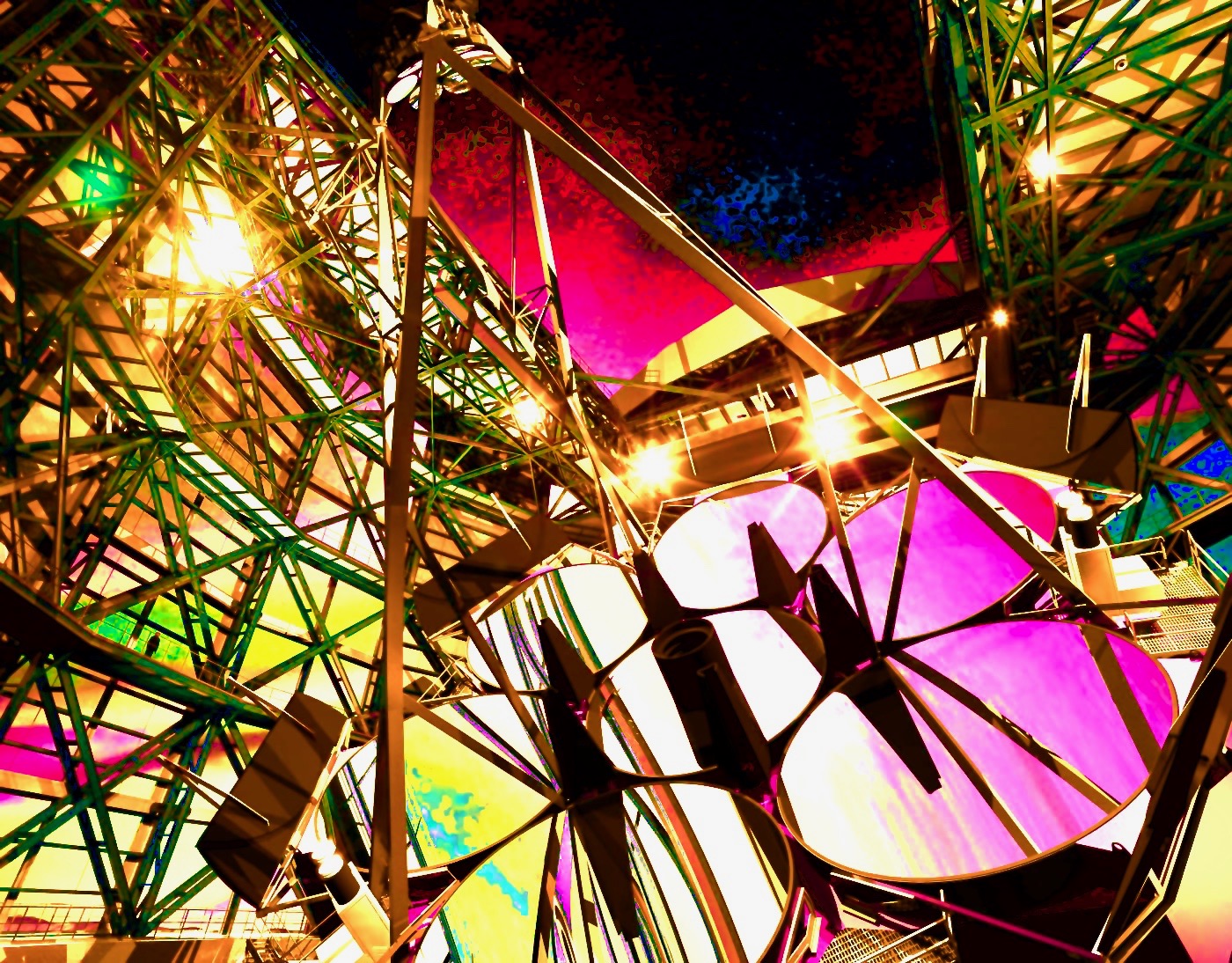
As the Monsoon period is coming to an end, the weather has stunningly improved to the most perfect conditions as the massive Singularity Observatory Amped 1,800-inch diameter telescope is rolled out into position for some truly stellar observing!

News Alert! After a recent two months in hibernation due to a total sky blanket caused by the Monsoon period over the Pacific Ocean, SPACE1 has opened the door to Singularity Observatory and awakened the beast. As the sky increasingly clears, the extremely massive amped telescope now has numerous tricks to emblazon operational results after having the previous year to gain incredible operational knowledge.

This is the fantastic Xtelescope that gave spectacular views of Mars during 2018 opposition. Stay tuned here as we publish the telescope's most amazing and mind boggling photos and discoveries. The great journey is just beginning! We will publish general overview information on telescope performance at the blog site. Those lucky friends having direct email correspondence with Humanoido will have the most fantastic information, photos, and material sent out free as it becomes available.