Location Location Location
A large number of people have asked about the location of SPACE1. Where do mighty and all powerful rockets blast off into space and head to places beyond the Earthly confines of mere mortals? Where is the home that these fiery rockets return? The best answer is given below.
Independent Pacific Ocean: The map shows the super vast realm of the Pacific Oceanic location of SPACE1 (Pacific Ocean, Pacific Rim, Asiatic Pacific, Deep Pacific, Independent Pacific, Mid Pacific, Tropical Pacific, Offshore Pacific). This vast territory is unclaimed ocean water, however, it holds a select scattering of volcanically-formed islands, island chains, isolated island mountains, sporadic islands, and archipelagos, inclusive of magnificent rising majestic mountain spires from the greatest depths of the isolated ocean.
Out here, there's the great beauty of nature supplanted by deep rich jungles of vast species, many of which are rare and unknown. It's the place where oxygen is manufactured for the Earth by natural undisturbed growing vegetation, where fascinating weather can provide the most geological stable and steady platforms for launching rockets and conducting the greatest astro and aerodynamic science. There was a reason the famous evolutionary scientist Charles Darwin, who changed world understanding of biology, set anchor at the Pacific Ocean - on the archipelago of volcanic Galapagos Islands - to do his revolutionary science on The Theory of Natural Selection.
— When people asked Buzz Adrin, man on the Moon in 1969, "why would you go to that barren place?" Buzz replied, "Location location location." SPACE1 feels the same about its prized location for space operations in the Pacific Ocean. —
SPACE1 has moved several times, each time resulting in a greater location and improvement for space science. Finally in 2018, during the most recent move, Humanoido moved his Space Empire and SPACE1 Headquarters was relocated from the USA, moving all operations to the tropical Pacific Oceanic volcanic jungle mountain spires of great majestic beauty with ultimate privacy for continuing uninterrupted extremely advanced space science studies and conducting non-military private civilian rocket launches, building machines, inventions, and systems to conduct space science and space tourism.
According to scientific geological studies, these huge volcanoes with mountain spires may be active but on an evolutionary time scale at the order of hundreds of thousands of years. The risk of one erupting in this lifetime is minimal.
Space1 Industries, a division of United Space Technologies, is a bold new space venture, taking you safely into space with futuristic technology. The mission - to the moon, planets and new worlds!
Showing posts with label jungle. Show all posts
Monday, May 6, 2019
Wednesday, April 24, 2019
Space1 Earth Sciences Mission Rocket Launch
Manned Rocket Launch
Breaking News: Tuesday, March 5th, 2019
The 13th Successful Space Launch - SPACE1 launched the secured Manned Earth Sciences Mission today, a smooth and flawless rocket launch and mission for Earth, Weather, and Geological Survey from space.
Conducted by EM Rocket Astronaut and Mission Flight Commander Humanoido, the rocket craft was engaged over the far distant mountain ranges to the East. Little if anything was thought to reside inside and on these harsh jungle tropical mountains, but new space reconnaissance proved different.
Results were amazing and astounding. While one weather front blocked closer mountain detail during the initial launch and during the rocket aspiring phase, the one hundred mile farther in distance mountains yielded far more detail than ever expected. Depending on the backdrop and the degree of silhouette from solar lighting, the amount of moisture in the atmosphere and Tropospheric condition, more or less detail was visible at the mountain peaks. It appears either civilian or a military operation and commandos have already supplanted the towers, communications antennas and equipment. Buildings not visible may have camouflage. Conditions for mapping the 100-mile long stretch of peaks were ideal but fleeting.
Thursday, October 18, 2018
Space1 Singularity Observatory Life Sciences
![]() |
| Moon above mountain ranges, iPhone + fisheye |
![]() |
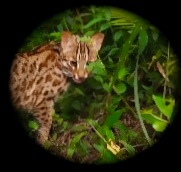
| Typical animal life living on mountains |
at Singularity Observatory
During the Typhoon and Monsoon periods, the telescope is decommissioned from astronomical and rocket space ship observational missions. However, a new life sciences mission is now in the works.
Off in the distance some miles away lies three great mountain ranges harboring a vast jungle/forest. The telescope is so powerful, it can zoom into the thick jungle brush and spot thousands of various life forms for study.
In the example photo, a Leopard cat is one among thousands of indigenous species. Other life forms include various mammals, birds, reptiles, and large insects. It's possible to research and catalog life living in the forest for various conservation programs. Photo of the Moon and mountains shot during the day with an iPhone camera and added fisheye lens in zoomed mode.
Subscribe to:
Posts (Atom)